|
Frequently Asked Questions
What day is
the 4th of July Parade?
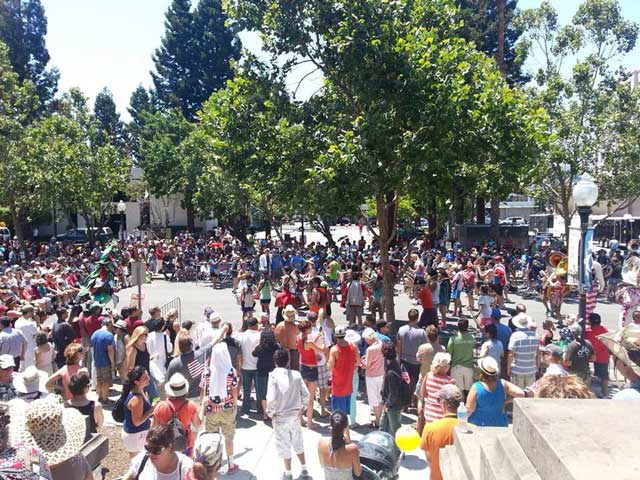
Believe it or not, this is our most frequently asked question. Our
celebration always happens on July 4th no matter what day of the week it
is.
How long is
the parade?
The length of the parade is about 1.25 miles. The time it takes to march
the route is 40 – 50 minutes. The first unit steps off at 10:00am and
the last unit will cross the finish line about 12:30pm.
What does the
entries committee look for?
Above all, you must be entertaining! You must be something that people
would not see any day on the street. Also, you must be capable of moving
down the street at about 2 miles/hour for almost two miles. We also
screen out entries that promote any political, religious, social,
economic or personal agendas.
How can I put a
good entry together?
You are welcome at any parade workshop. This 2 hour workshop is designed
to help you put together a great entry, and have fun doing it. They are
open to the public, and you are not obligated to enter the parade by
taking the workshop.
Why aren’t
there more marching bands?
Alas, there are two main reasons. First, most of our school bands do not
march in the summer. Second, there are relatively few music programs in
our local schools. A marching band needs a tremendous amount of support
from parents, faculty, and administration plus good programs in
elementary schools to train the musicians to that level. We would love
to see more bands; if you know of any that are willing to come please
email us.
Why aren’t there
more floats?
Actually, we have a relatively high number of floats in our parade. The
Peninsula Celebration Association will rent float chassis to groups for
the parade, and we teach a workshop on how to design and build one. But
a group has to be willing to put in the time and effort to make a float.
Our parade is only as good as the community that supports it.
Where is the
parade route?
The parade starts at Winslow & Marshall at 10:00am and loops around
downtown Redwood City. It travels on parts of these streets: Marshall,
Main, Middlefield, Broadway and Arguello.
How do I get
there and where do I park?
If you can, we advise you not to drive. The best way to get to the
parade site is to take Caltrain to the Redwood City station. The parade
is literally on the other side of the tracks. You can also take a
Samtrans bus down to El Camino to stops between Brewster and Jefferson.
Just follow streets east of El Camino to the parade route. If you have
to drive, take hwy 101 to either Woodside Road or Whipple Avenue. Go to
Veteran’s Blvd. and park in the areas west of Marshall St.
Wow! How much
does it cost the City of Redwood City to put this on?
Actually, the July 4 Celebration activities are sponsored and totally
managed by the Peninsula Celebration Association, a private non-profit
volunteer organization. The Peninsula Celebration Association pays for
the celebration, including the cost of the prize money in the parade.
However, the City of Redwood City does generously support the event with
police and fire protection, the use of the city streets, and set up and
clean up services provided by Public Works.
This sounds like
fun! How can I help?
We can use volunteers all year round, especially in May, June and early
July, and we can use up to 40 volunteers on the day of July 4. Call our
office for details or see our
volunteer page.
Independence Day Trivia
The American flag is
made mostly of wool, with cotton stars. The flag was made by Mary
Pickersgill and her 13 yr. old daughter, in Baltimore in 1813. Lt. Col.
George Armistead ordered it to fly over Fort McHenry in Baltimore during
the War of 1812.
The flag was about 3 stories (30 ft) high and 42 ft long. The flag was
so big that no room in the Pickersgill home could fit it, so they took
it to a local brewery where it could be stretched out.
Our flag is no longer hanging in the Smithsonian Institution, where it
has been on display since 1907. For the next 3 years that flag will be
undergoing preservation work in a lab specially designed for visitors to
watch--at the Smithsonian's National Museum of American History in
Washington, DC.
In 1914, the Smithsonian tried to preserve the flag. They hand-sewed a
linen backing onto it using about 2 million stitches. The backing is
wearing out; someday it might not support the flag. The backing can't be
pulled out--it will take experts two snips per stitch (2 million
stitches) to take it apart. It will take about a year to remove the
backing only.
The cost of making the flag was $405.90--the cost of preserving the flag
totals about $18 million. Before preservation work began, scientists
took special pictures of the flag to tell areas/spots that needed extra
care. When the backing is removed, 10 experts will clean the flag using
a special vacuum and dry cleaning products. When finished the flag will
be place in a climate controlled viewing case.
One reason for the War of 1812 was that the British had been attacking
American Ships--they wanted to stop Americans from trading with their
enemy, France. The British captured American sailors and forced them to
serve in their navy. In 1814, British invaded Washington DC, burning the
Capital and White House.
William Beanes, a doctor, organized a posse to jail these British
troublemakers, but the British captured him and took them to their ship.
Francis Scott Key, a lawyer went aboard to negotiate Beanes release.
Key was held prisoner for 10 days--he wasn't allowed to leave until the
British finished bombing Fort McHenry. On Sept. 13, Key watched the
British fire 1,800 bombs on the fort. About 2 am the firing stopped, he
thought this meant the Americans lost. In fact, the British stopped to
secretly land troops, but when this failed they began bombing again at 4
am.
Finally at dawn, Key could see the flag still flying--the Americans
hadn't lost!
Key wrote our national anthem on a letter from his pocket after seeing
the American flag in the midst of being bombed. He called his song "The
Defense of Fort McHenry"-written to a popular British tune. He had
written several songs to this tune before. His song was a hit right away
and Congress made it our National Anthem in 1931. |